
Elif Bozkurt & Barış Coşkun
One of the greatest legacies of the anti-trustee struggle at Boğaziçi University began with Mehmed Özkan, Boğaziçi’s first trustee-rector. This legacy grew with the appointment of Melih Bulu and reached a nationwide audience. Undoubtedly, it is the transformation of the Student Representative Boards (SRCs) into mechanisms of struggle. Once used as a stepping stone for student careers, the SRCs have now permeated every aspect of student life. They organise academic boycotts and handle everyday efforts, such as addressing water outages in dormitories.
We, as Boğaziçi students, united under the motto “Voice, Authority, Decision to the University Components” during the 2021 Resistance to demand a greater role in university governance. Our movement opposed the top-down appointment of rectors, deans, and academics by a single decree. We continue our struggle to introduce this representative mechanism to the university senate, with the goal of ensuring direct student participation in decision-making.
Behind-the-door decisions about our universities prioritise the interests of capital and the current government over those of students, academics, and workers. These decisions have led to the closure of dormitories, their replacement by technoparks, delayed reconstruction of our unsafe library under the pretext of saving public funds, and the transfer of limited study and common spaces to private interests. We reject both the legitimacy of these decisions and those responsible for them. When authorities claim insufficient funding for student needs, we respond, “Open your books; then we’ll see.” Therefore, our struggle is about defending our democratic rights, as well as fundamental rights such as access to quality housing and food.
The trustee regime is undermining our fundamental rights as students. Through mail-order appointments of academics, our right to quality education is diminished. Heavy pressure on the SRC and bans on clubs restrict our freedom of association. SRC representatives face investigations and have their representation revoked, while club rooms are seized and elected students are unlawfully dismissed. Club activities are suspended, and our cinema club is subject to arbitrary decisions. Despite these restrictions, we unite in clubs and the SRC, amplifying our demands for a democratic university.
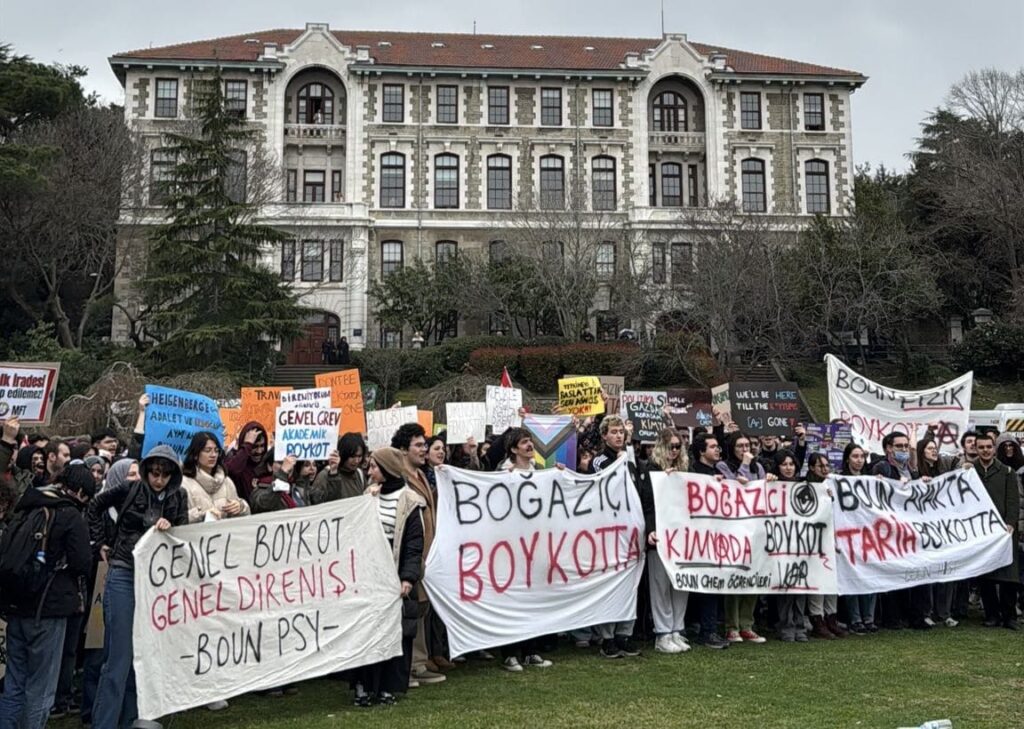
The mobilisation that began with the March 19th protests highlighted the crucial role these organisations play at Boğaziçi University. During this period, universities began to establish representational mechanisms. At Boğaziçi, our primary goal was to design our SRC, informed by past experiences, as democratic and transparent as possible, thereby demonstrating our commitment to representation and transparency. We held departmental meetings, discussions, and surveys. While striving to maintain coordination within the university, we also established communication with our colleagues at other universities and developed specific tools to facilitate this communication. We marched alongside tens of thousands of students in the Maçka-Şişli protest, organised by university students, to declare, “End the Trustee Regime from Universities to Municipalities!” Because we know that the arrests of elected mayors and the dismissal of elected student club leaders are the product of the same oppressive policies, the trustee appointed to the Şişli Municipality and the trustee appointed to Boğaziçi are puppets of the same regime. All these anti-democratic practices belong to a trustee regime that is organised from top to bottom, planned and programmed. Hence, we need an organised and programmed resistance to be able to cope with these oppressive policies.
At this point, as previously mentioned, it is crucial for university youth to raise their demands for a democratic university both locally and nationally. The SCR mechanism, which initially saw students collectively discussing their universities, starting with their own departments, combining the resulting demands and needs with those submitted by other departments through representatives and presenting them to the university administration, ultimately gave the student body a direct say in university decision-making, has ultimately become the primary source of the years-long “Boğaziçi Resistance.”
Besides being organised and planned, our resistance also requires mass mobilisation. The slogan of the Maçka-Şişli protest, “Students Boycott, Unions Take to the Streets!”, the slogans we chanted during the protests —such as “General Strike, General Resistance!” —and the open letter we, as Boğaziçi students, issued to workers and labour organisations, all served this purpose. Since the developments occurring in our universities are not isolated from the country’s political and economic climate, our resistance must not be confined to campuses. Dispelling the clouds of fear and ensuring political democracy is not a burden students can shoulder alone. The only way to break free from our shackles is to carry our voices beyond university walls, into the streets, factories, and workplaces, and for students, workers, and the oppressed to weave a struggle hand in hand.
As we have repeatedly cried out in unison, “This is just the beginning, continue the struggle!”
With love and solidarity from Boğaziçi University, which always belongs to us students…


Leave a Comment
Your email address will not be published. Required fields are marked with *